Commercial Dock Leveler Maintenance: The Complete Property Manager's Guide
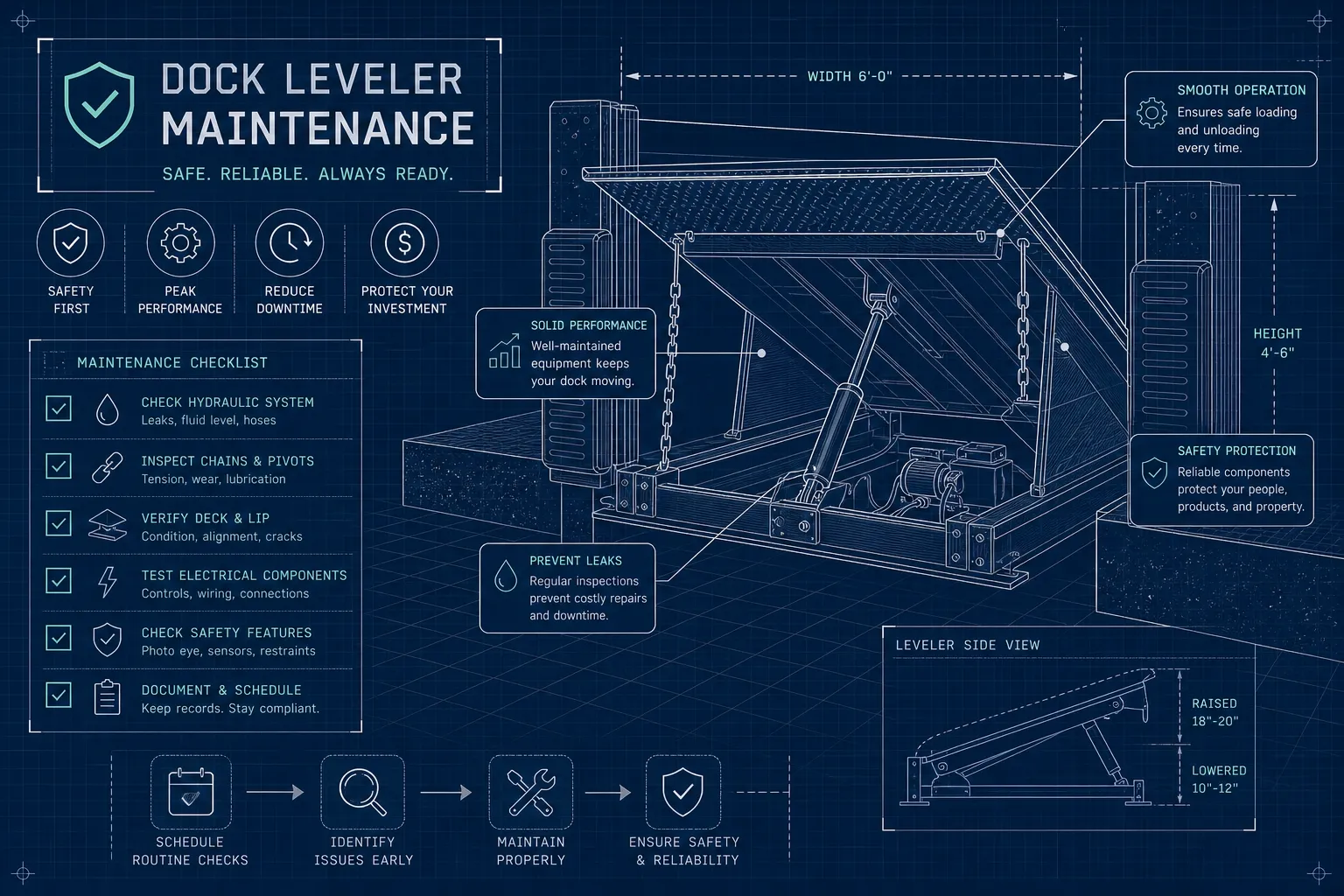 Commercial dock leveler maintenance is one of the most consequential items a property manager can either schedule or ignore, and most facilities don't think about it until they're paying emergency rates on a Monday morning. Picture this: it's the start of the week at your warehouse, the first truck is backed into Bay 3, and your forklift operator is standing idle because the dock leveler lip won't extend. The unit "worked fine Friday." Now you've got a blocked shipment, an irritated driver, and a repair call at premium cost. This isn't bad luck. It's the predictable result of a maintenance gap that structured commercial dock leveler maintenance would have caught weeks earlier.
At JR Garage Door and Services, the team regularly responds to emergency dock leveler calls from Maryland warehouses and industrial facilities, and those calls frequently trace back to the same root cause: no documented maintenance schedule. A little structured attention to lubrication, fluid levels, and mechanical wear would have flagged the problem long before it became a dispatch. This guide gives you that structure.
You'll find inspection frequencies for each leveler type, a practical commercial dock leveler maintenance checklist, hydraulic fluid assessment guidance, warning sign diagnostics, OSHA compliance basics, and a clear threshold for when the job needs a licensed contractor.
Why Commercial Dock Leveler Maintenance Can't Be an Afterthought
The Real Cost of Skipping Preventive Care
Reactive maintenance on a dock leveler costs significantly more than a scheduled service visit. Hydraulic cylinder repairs, seal replacements, and hose failures are parts-and-labor jobs that can easily outpace what a full year of preventive maintenance would have cost, often by a wide margin when you factor in emergency labor rates. Beyond the repair bill, unplanned downtime disrupts your entire dock operation: carriers leave, labor hours go to waste, and your shipping schedule takes a hit that ripples through the week.
Preventive maintenance contracts for commercial dock levelers typically run around $400 per bay per year. That figure covers inspections, cleaning, lubrication, adjustments, and a written deficiency report. Compare that to a single emergency hydraulic repair, and the math is simple. PM is an operational expense; emergency repair is a penalty for skipping it.
How Leveler Type Shapes Your Maintenance Approach
Not all dock levelers fail the same way, and treating them like they do is how problems get missed. A hydraulic pit-mounted unit requires fluid condition checks, cylinder seal assessments, and valve block inspections that a mechanical leveler doesn't need. An edge-of-dock leveler has different wear patterns at the lip spring and hinge mechanism than a full pit-mounted unit. A mechanical leveler depends on spring tension and hold-down assemblies that need specific testing.
The schedule outlined below accounts for these differences. Know which type of leveler is at each bay before you build your maintenance routine, because the inspection points differ enough to matter.
Commercial Dock Leveler Maintenance Schedule: What to Do and When
What the Operator Checks Before the First Truck of the Day
Daily checks belong to the operator, not the maintenance team. Before the first cycle of the day, the operator should clear debris from the pit area and deck surface, run the unit through a full cycle, and listen for any new noise or hesitation. Confirm the lip extends fully, seats correctly on the trailer bed, and that the unit returns to stored position without resistance. This process takes only a few minutes and should be part of every dock operator's start-of-shift routine.
This isn't a formal inspection, it's a trained eye doing a quick scan. Operators who know what "normal" looks and sounds like are the first line of detection for developing problems. A grinding noise caught immediately is typically a minor issue. The same noise ignored for weeks often becomes a repair that sidelines the bay entirely. Report any new sounds or sluggish operation the same day they appear.
Monthly Tasks That Catch Problems Before They Grow
Monthly maintenance is where the facility team gets hands-on. Inspect all mounting hardware and anchor bolts for looseness. Check bumper condition and weather seals. Run a full functional test and document the results. Lubricate pivot points, hinge tubes, lift arms, and release linkages using water-resistant, extreme-pressure lubricants specified for those components. For a practical procedural reference, consult a dedicated how to maintain your dock levelers guide that walks through common lubrication and inspection steps.
For hydraulic units, the monthly check also includes a visual inspection of hoses and fittings for weeping or moisture, plus a fluid level check. If the level has dropped since last month, there's a leak somewhere. The fluid level itself is a diagnostic indicator, not just a maintenance task.
Quarterly Inspections for Long-Term Reliability
Quarterly checks go deeper than what your in-house team can reasonably handle alone. Structural weld integrity, full-cycle performance testing under operating load, and spring tension review on mechanical units all belong here. For hydraulic levelers, cylinder condition, valve block function, and full pressure testing require equipment and expertise that justify a licensed contractor visit.
For high-traffic docks, quarterly is the minimum professional touchpoint. A leveler cycling dozens of times per shift accumulates wear faster than one used a few times a day. Match your inspection frequency to actual usage volume, not just the calendar.
Commercial Dock Leveler Maintenance Checklist: Lubrication, Hydraulics, and Lip Hinge Inspection
What to Lubricate, How Often, and With What
The lubrication points on a dock leveler include lip hinge tubes, rear hinge pins, pivot pins, lift arm rollers, counterbalance components, and release linkages. Hinge tubes call for light oil applied until the lip moves freely. Pivot pins and rear hinge pins call for grease. Manufacturer guidance is consistent on one point: use water-resistant, extreme-pressure lubricants at pivot and hinge points. General-purpose spray lubricants are not a substitute.
Lubrication frequency should be monthly for moderate-traffic docks. High-traffic facilities will need lubrication more often, in some cases every few weeks, depending on cycle volume and environmental conditions. Follow manufacturer recommendations and adjust based on actual wear patterns. The trigger is function, not just the calendar: if a component is noisy, stiff, or dirty, lubricate it. Document every application so you can track intervals against wear patterns over time.
Use this as your baseline dock leveler lubrication and repair reference for each service visit:
- Lip hinge tubes: Light oil; apply until lip moves freely
- Rear hinge pins: Extreme-pressure grease
- Pivot pins: Extreme-pressure grease
- Lift arm rollers: Water-resistant grease
- Counterbalance components: Per manufacturer spec
- Release linkages: Light oil or grease per component type
Hydraulic Fluid Checks Most Facilities Get Wrong
Checking the reservoir level is only the starting point. What you're really assessing is fluid condition. Dark fluid signals thermal degradation from repeated cycling without fluid changes. Cloudy or milky fluid means water has entered the system, which causes accelerated seal wear and internal corrosion. Visible particles in the reservoir indicate contamination that will damage the pump and valve block if left unaddressed.
A drop in reservoir level is a symptom, not a root cause. Low fluid almost always means there's an active leak: a hose, a fitting, a cylinder seal, or a connection point. Find the source before topping it off. Replace fluid based on condition and manufacturer-recommended intervals; dark, cloudy, or contaminated fluid should be drained and replaced rather than simply topped off. Cycling degraded fluid through a hydraulic system shortens the life of every component it touches.
Lip Hinge Inspection Points That Get Overlooked
A lip that extends slowly, won't fully engage with the trailer bed, or drops too early almost always traces to the hinge and spring assembly, not the operator. During your inspection, check for cracking or deformation at the weld points where the hinge tube meets the lip. Look for worn or elongated hinge tube bores, which allow slop in the pivot and cause inconsistent lip travel. Check lip assist spring condition for fatigue or loss of tension.
Also inspect the lip steel itself for any bend or warping from repeated impact loading. A forklift that repeatedly hits the lip at the wrong angle creates cumulative damage that isn't obvious until the lip stops functioning correctly. Catch this during a routine inspection, and it's an adjustment or parts swap. Miss it, and you're looking at a structural repair.
Warning Signs Your Dock Leveler Is Signaling a Bigger Problem
Mechanical and Structural Red Flags
Some warning signs are visible; some you feel through the operation. A deck that won't sit flush at the trailer creates a gap that's a forklift hazard and a sign of structural damage or mounting failure. Excessive bounce or instability when a forklift crosses points to worn pins, loose welds, or bushing wear. A lip that won't stay extended traces to hinge wear or spring fatigue. Grinding or clunking during a cycle points to metal-to-metal contact somewhere in the mechanical system.
Diagnose symptoms by subsystem, not by assuming the worst. Instability at the deck points to structural or fastener issues. Lip failures point to hinges and springs. Deck gaps at the trailer point to mounting or frame damage. Each symptom narrows the inspection area and helps you prioritize the repair.
Hydraulic and Electrical Indicators to Take Seriously
On hydraulic units, visible puddles under the bay, weeping hose fittings, and sluggish cycle times are all signs the system is losing integrity. A deck that drifts downward or away from position under load is a serious safety hazard: it means the hydraulic system can no longer hold pressure reliably, which is often caused by worn cylinder seals, a leaking control valve, or low fluid from an undetected leak.
For electrically controlled units, intermittent control response and limit switch failures indicate wiring degradation or sensor problems. The clear rule: if the leveler won't hold position reliably under load, take that bay out of service immediately. A dock leveler that drops unexpectedly under a loaded forklift is a serious injury risk, not a minor inconvenience.
Safety Testing and OSHA Compliance Requirements Every Facility Must Meet
Functional Safety Tests That Should Be Part of Every Quarterly Inspection
A proper quarterly safety test means more than watching the leveler go up and down. Cycle the unit repeatedly through its full operating range. On mechanical units, confirm the safety leg engages correctly and holds the deck at rest position. Confirm the lip locks securely at trailer height. Verify that the unit returns to stored position safely after unloading. For hydraulic units, apply a static load and confirm the deck holds position without drifting over several minutes. Document every result.
If a safety test reveals any failure, the deck drifts, the safety leg doesn't hold, or the lip won't lock, pull that bay from service immediately, tag it out, and schedule a contractor visit before the unit cycles again. One failed safety check doesn't mean the equipment is at end-of-life; it means it needs professional diagnosis before anyone runs a load across it.
Lockout/Tagout and Documentation Requirements
OSHA 29 CFR 1910.147 governs energy control during dock leveler maintenance. Any powered dock leveler, whether hydraulic or electrically controlled, must be locked out and tagged before maintenance begins. That means written procedures developed for each specific unit, covering the exact sequence: shutdown, energy isolation, pressure bleeding for hydraulic systems, verification that the deck is at rest, and confirmation that stored energy has been released before any hands-on work starts. For a formal example of dock leveler lockout procedures, see the dock levelers safety lockout procedures guidance.
Beyond lockout/tagout, OSHA expects written maintenance records to demonstrate compliance and protect equipment warranties. Documented inspections, lubrication logs, and deficiency reports serve a second purpose: they create a baseline across multiple bays that makes it easier to spot recurring problems before they cause a failure or an incident. For additional regulatory context, review the OSHA enforcement directive relevant to equipment safety and enforcement practices.
When to Stop DIYing It and Bring In a Licensed Commercial Contractor
What a Professional Preventive Maintenance Visit Actually Covers
A licensed contractor doing a scheduled dock leveler service goes well beyond what in-house maintenance can replicate. Structural fastener torque checks, hydraulic system pressure testing, cylinder seal assessment, weld integrity inspection, and calibrated full-cycle testing under real operating conditions all require tools and expertise that aren't standard facility equipment. A professional visit also produces a written deficiency report that documents exactly what needs attention and what's in acceptable condition.
At roughly $400 per bay per year, a PM contract covers inspection, cleaning, lubrication, adjustment, and documentation. Parts and major repairs are billed separately, which means you get a clear picture of what your equipment actually needs rather than a bundled invoice that obscures the details. If you're evaluating vendors, consider service providers listed under Commercial Garage Door Services | Charles County, MD who perform regular dock and door maintenance to accepted industry standards.
Why Scheduling Matters More Than Reacting
A contractor familiar with your specific equipment (brand, age, cycle volume, and repair history) catches developing problems while they're still inexpensive. Reactive service means paying emergency rates for a problem that's been building for weeks. Scheduled commercial dock leveler maintenance means paying standard rates to prevent that problem from materializing at the worst possible time. Guidance on recognizing service intervals and when a leveler needs attention can be found in industry service resources such as is it time for your loading dock leveler to be serviced.
JR Garage Door and Services provides scheduled commercial dock leveler maintenance for warehouse and industrial facilities throughout Maryland. The team works with hydraulic, mechanical, and edge-of-dock units and builds service schedules around each facility's traffic volume and compliance requirements. One call sets up the program; one visit can prevent months of unplanned downtime.
Put the Framework in Place Now, Not After the Next Breakdown
Effective commercial dock leveler maintenance runs on three non-negotiable layers: daily operator checks, monthly lubrication and condition reviews, and quarterly deep inspections. Each layer catches what the previous one misses. Skip any layer consistently, and you're not doing preventive maintenance, you're hoping for a lucky streak.
Document every inspection. Address warning signs before they escalate into failures. Don't wait for a broken leveler to schedule professional service. The cost difference between a scheduled PM visit and an emergency hydraulic repair makes the case on its own.
If your facility doesn't have a documented dock leveler maintenance schedule in place, now is the time to build one. Call JR Garage Door and Services for a free loading dock assessment and a service schedule built around your operation. Reach us directly by phone or through our contact form to get started, learn about our Garage Door Maintenance Packages | Charles County, MD, or browse our Commercial Doors | Charles County, MD gallery to see examples of our work.
/filters:no_upscale()/filters:format(webp)/media/aabadf45-2e53-4c38-aff8-7e01c1ed7984.jpeg)
/filters:no_upscale()/filters:format(webp)/media/29ca6e21-4382-4a34-905c-46a567b424f1.jpeg)